



The ‘Hamba Juba’ Royalties Dispute: Amapiano’s Hit That Exposed a Broken System
-

- October 9, 2025

When Hamba Juba dropped in 2023, the amapiano world was on fire. The song was an instant anthem, a melodic fusion of emotion and rhythm performed by Lady Amar, Cici, Murumba Pitch, and JL SA, and produced under the guidance of Sfiso Ndlovu, a rising music manager, podcast host, and label owner known for co-hosting the Piano Pulse podcast.
The track didn’t just take over South Africa; it went global. With over 23 million streams on Spotify and more than 34 million views on YouTube, Hamba Juba became a symbol of the genre’s power, proof that the amapiano wave could capture the world’s imagination without compromise.
Behind the scenes, however, that harmony was slowly unravelling.
When the Music Stopped Paying
Two years after the song’s release, in September 2025, one of its key contributors, JL SA, took to social media to reveal a painful truth: he had never been paid for his work on the hit.
“I produced the song from scratch; this is my work, my own production, but I never got a cent for it,” he said in a now-viral TikTok video. “If you check now, the song is sitting on millions of streams. I love making music, but the sad part is that I don’t get paid for it.”
The video triggered an outpouring of support from fans and artists alike, with many calling it yet another example of exploitation in the music industry. Soon after, Lady Amar confirmed the same experience. In her own video, she stated, “I don’t know the Hamba Juba money, not even a cent. I have never received anything. It’s been two years and nothing.”
What had begun as a celebration of amapiano unity quickly turned into a public dispute over royalties, rights, and respect.
The Accused: Sfiso Ndlovu Responds
At the centre of the controversy was Sfiso Ndlovu, the host of Piano Pulse and the individual who reportedly holds the rights to Hamba Juba. When the allegations surfaced, Ndlovu addressed them head-on in an episode of his own podcast, confirming that he had indeed withheld payment.
But his reasoning shocked many. “The reason why I did not pay JL at the time,” Ndlovu explained in isiZulu, “was because bengifuna ukumnyisa, I wanted to teach him a lesson, because he breached my contract, and I know the law.”
Ndlovu insisted that he had every legal right to withhold the royalties, claiming that JL SA had violated their agreement, though he did not specify how. JL SA, for his part, denied any breach, saying no such contract existed or was ever signed.
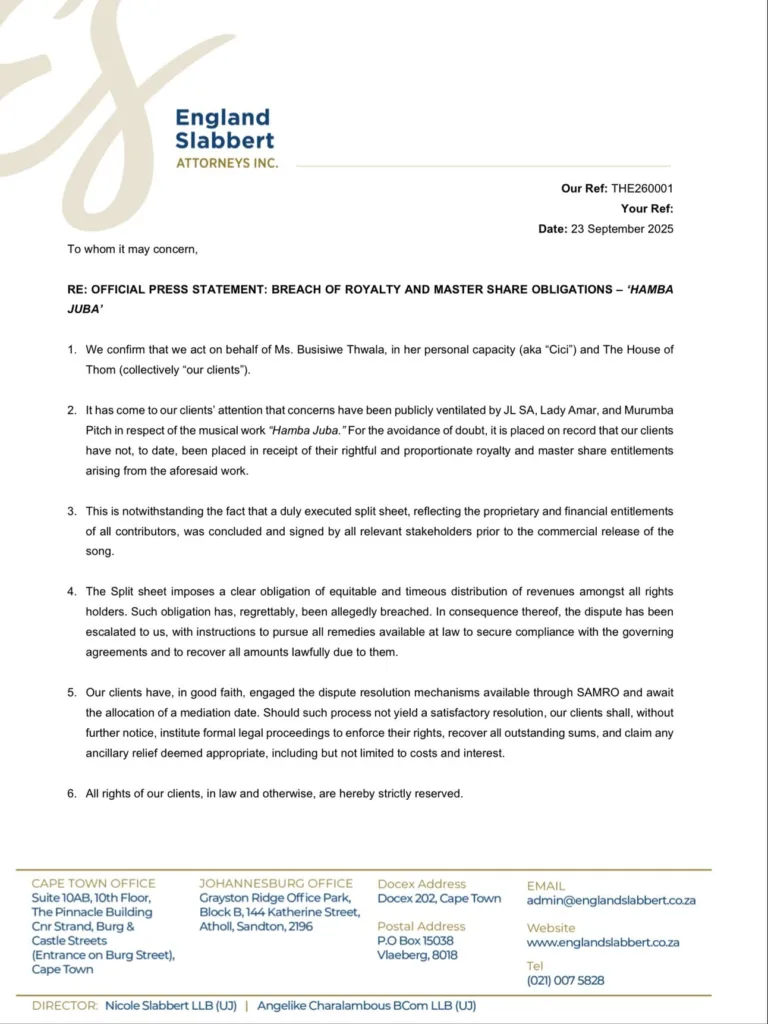
The drama deepened when Ndlovu revealed that singer Cici, another collaborator on the song, had taken him to court over unpaid royalties. According to him, the money was currently being held back by the South African Music Rights Organisation (SAMRO) pending verification of ownership splits.
“The money was blocked before I could pay Sony,” Ndlovu said. “JL must just go and say Sfiso wrote this song. If he does that and sends that email, SAMRO will release the money. Then I’ll take that money and send it to Sony, and then Sony will pay him.”
In the eyes of the public, this explanation did little to repair his image. Many accused Ndlovu of hypocrisy, pointing out that he had previously used his podcast to criticise others in the industry for failing to pay artists their royalties.
The Industry Reacts
The Hamba Juba saga didn’t exist in isolation; it reopened old wounds in the South African music industry, particularly within amapiano. In recent years, the genre has become both a cultural treasure and a minefield of disputes, where success stories often come hand in hand with legal chaos.
From DJ Maphorisa being accused of exploiting collaborators to G Mashego, the “Biri Marung” hitmaker, claiming he was stranded in Nigeria without pay, amapiano’s reputation for informal business practices has been repeatedly exposed.
The industry’s rapid growth has created opportunities but also confusion. Many producers, vocalists, and songwriters operate without proper contracts or clear agreements about royalties and credits. Collaborations often begin with shared excitement but end in silence when the money arrives, or doesn’t.
Amapiano’s strength has always been its community-driven nature, its sense of collaboration, and its cultural pride. Yet that same openness has made it vulnerable to exploitation, misunderstanding, and mistrust.

The Root of the Chaos: Missing Contracts and Mismanaged Rights
At the core of the Hamba Juba dispute lies a problem that has haunted African music for decades: the lack of clear documentation and rights management. Many artists assume that friendship, trust, and verbal agreements are enough, but when real money enters the equation, that trust quickly dissolves.
In South Africa, royalty payments are managed through organisations like SAMRO (for performance rights) and CAPASSO (for mechanical rights). These entities rely on accurate metadata and registration information from artists and producers. If one party registers the song incorrectly or claims sole ownership, payments can be frozen, misdirected, or lost entirely.
The lack of split sheets, unregistered agreements, and ignorance about intellectual property law means that the same cycle repeats itself over and over again, a hit song becomes a hit problem.
Sfiso’s Reputation and the Public Perception
For Sfiso Ndlovu, the controversy hit particularly hard because of his public persona. As a host of Piano Pulse, he often discussed the very issue now haunting him, the alleged exploitation of artists by managers and record labels.
In previous episodes, he had criticised “industry gatekeepers” for stealing from creators. Now, many see the Hamba Juba scandal as ironic and damaging, with critics saying he has become what he once condemned.
Social media platforms lit up with debate. Some defended Ndlovu, arguing that contracts must be respected, while others said his “lesson” sounded like an abuse of power. For JL SA and Lady Amar, the fight for payment became symbolic of a much larger battle for fairness and recognition in the fast-evolving world of amapiano
The Teachable Moment: Fixing the Foundation
The Hamba Juba dispute is more than a scandal; it’s a mirror reflecting the gaps in South Africa’s music ecosystem. It’s not just about one song or one artist; it’s about an entire generation of creators learning hard lessons about ownership, documentation, and accountability.
Artists must start seeing themselves not just as performers but as entrepreneurs and rights holders. Every beat, every lyric, and every melody is intellectual property, a digital asset that must be protected. Before the release of any song, artists should agree on split sheets, outlining who owns what percentage of the track.
They must also register their works correctly with SAMRO, CAPASSO, and their distributors, ensuring that their contributions are recorded in the metadata. If disputes arise, they must file official claims to freeze payments rather than rely on social media to plead their case.
Legal support, though often seen as expensive, is no longer optional. Entertainment lawyers, copyright advisors, and artist unions exist to protect creative workers. One consultation can save years of frustration and loss.
If amapiano is to sustain its dominance as a global genre, it must evolve beyond its creative brilliance into structural maturity. The culture that once symbolised unity and opportunity must now embrace professionalism and protection.
Please Also Read:
The Hamba Juba saga, while painful, is a turning point, a wake-up call for the industry to prioritise clarity over chaos, integrity over impulse, and contracts over conversations.
For JL SA, Lady Amar, and countless others, the road to justice may still be long. But their courage in speaking out has sparked a necessary conversation. And for Sfiso Ndlovu and his peers, it’s a moment of reckoning, to rebuild trust and set a new example for how amapiano handles its business.
Can we build an industry that pays its people?
Music has always been one of South Africa’s greatest exports, a reflection of resilience, innovation, and soul. But to sustain that legacy, the business of music must evolve alongside the art.
The Hamba Juba dispute has taught us that success without structure leads to struggle. A hit song should not divide artists; it should uplift them.
As amapiano continues to travel the world, it carries with it the dreams of thousands of young creatives. It’s time to ensure those dreams are protected legally, fairly, and transparently. Because in the end, music may start from the heart, but it survives through the paperwork.


