

Scorpion Kings Live FNB Stadium: Inside the R75–R95 Million Business Behind One Night of Amapiano
-

- September 26, 2026
Forget the music for a moment. Let’s talk business.
On the evening of 19 September 2026, 74,000 people walked into FNB Stadium in Nasrec, Johannesburg and watched Kabza De Small and DJ Maphorisa do what they do better than almost anyone alive: make a stadium feel like a house party. The Scorpion Kings Live FNB Stadium concert was, by any measure, one of the most significant amapiano events in South African history. But beyond the spectacle- the stage design, the surprise guests, the ocean of people moving in perfect rhythm- there was something else happening. A business. A very large one. And understanding how it works is the real education.
We are not pocket-watching. We do not know Kabza or Maphorisa’s personal contracts, tax positions, or private financial arrangements- and those details are not ours to speculate on. What we can do is look at standard industry benchmarks, publicly available venue and ticket information, and the commercial structures common to events of this scale, and build a model that reflects how the business behind 74,000 people and a single evening actually works.
The Numbers: What a Scorpion Kings FNB Stadium Night Generates
FNB Stadium has an official seating capacity of 94,736 — the largest in Africa. As Wikipedia’s venue entry confirms, it features 195 executive suites and a seating capacity of 88,530. For a concert configuration, stage build-out and floor sections typically reduce available capacity, and the reported attendance of 74,000 for the Scorpion Kings event sits comfortably within a near-sellout scenario for a major music event. Here is how the revenue model maps out:
🎟 Ticket & VIP Revenue: R60 million – R75 million est. avg. R810–R1,013 per head across tiered pricing
🤝 Sponsorships, Brand Deals & Merch: R15 million – R20 million industry benchmark for SA stadium-scale events
📊 Estimated Gross Revenue: R75 million – R95 million+ before production costs
🏗 Production & Logistics Costs: R30 million – R45 million venue, sound, lighting, security, lineup, marketing
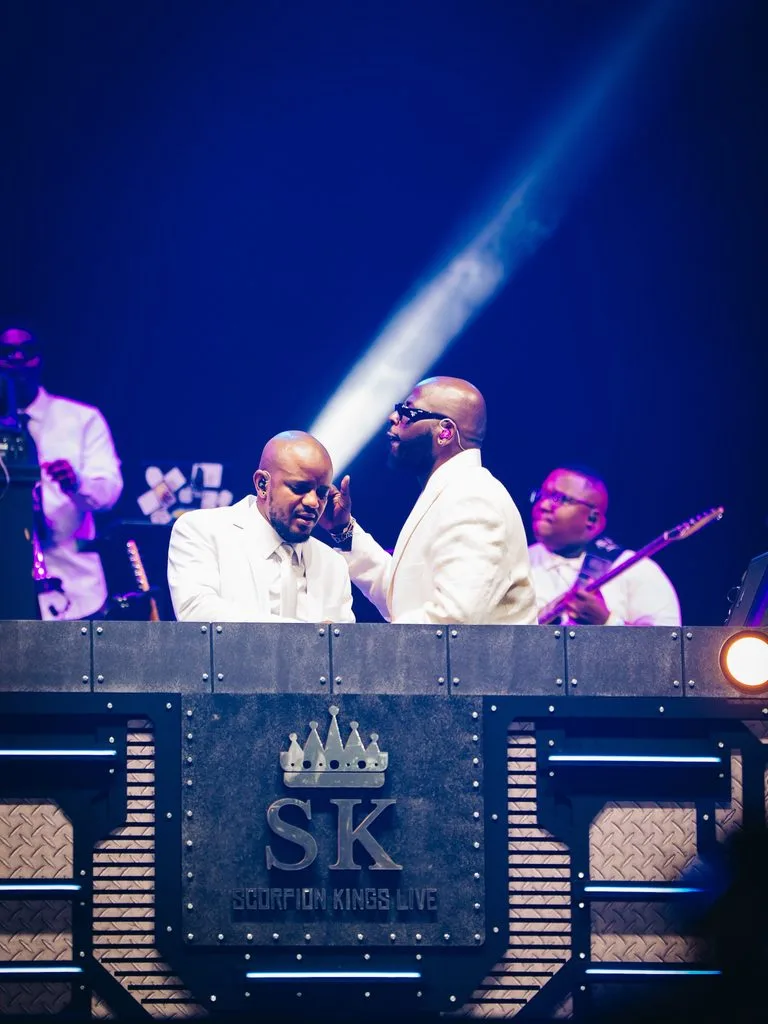
Scorpion Kings Live with Friends: Amapiano Royalty Light Up Pretoria
💰 Estimated Net Profit Pool: R30 million – R50 million across promoters, artists, and partners
Breaking down the ticket math: 74,000 tickets across a tiered pricing structure typical of South African stadium concerts – general admission, premium floor, VIP, and hospitality packages – would generate an average per-ticket yield of between R810 and R1,013 to reach the R60–75 million range. That is not aggressive. For comparison, Pollstar’s concert industry data regularly shows average per-ticket yields at major international concerts well above these figures, even after accounting for the pricing context of the South African market.
Where the R30–45 Million Goes: The Cost of a Scorpion Kings FNB Stadium Production
A show of this magnitude does not come cheap. Transforming FNB Stadium from an 88,500-seat football arena into a concert-ready experience requires significant upfront capital across every dimension of the production:
🏟 Venue hire, which for FNB Stadium is estimated in the range of R2–5 million for a major concert event, including production time for load-in and load-out.
🔊 Sound and lighting, which at stadium scale requires the kind of specification that rental companies typically price at R8–15 million for a single night – particularly where LED screens, line arrays, and delay towers must cover a 74,000-person floor.
🎤 Supporting lineup fees, which for a Scorpion Kings headline show would draw from the upper tier of South African amapiano and urban talent, collectively adding several million rand to the performance costs.
🔒 Security, staffing, and logistics, which for an event of 74,000 people – managed responsibly per South Africa’s Safety at Sports and Recreational Events Act – requires several hundred personnel and significant operational investment.
📣 Marketing and promotions, which for a national stadium concert typically runs 10–15% of projected gross revenue, placing the campaign budget alone at R7.5–14 million
What the Artists Could Have Taken Home: The Scorpion Kings FNB Stadium Upside
Here is where the entrepreneurial lesson sits. Depending on the specific promoter contracts and ownership structures — whether Kabza De Small and DJ Maphorisa performed under a guaranteed fee, a revenue-share arrangement, or as co-promoters with equity in the event — their combined take-home from a Scorpion Kings FNB Stadium night of this scale could realistically have sat between R12 million and R30 million, before tax, in a single evening.
The range is wide because the structure matters enormously. An artist performing on a flat guarantee takes their fee regardless of how well the show sells. An artist with promoter equity participates in the upside when 74,000 tickets sell and the sponsors come in strong. The most sophisticated acts in South Africa — and globally — have been moving toward the latter for years. As Forbes Africa has documented in its coverage of South African entertainment business models, ownership and co-production are where the real wealth generation happens in live music.
“Don’t just chase digital streams. Build a scalable business around the people streaming you.” –Yanos Plug Business Desk
The Real Lesson: Music is Just the Hook
There is a profound entrepreneurial insight embedded in the Scorpion Kings Live FNB Stadium story that too often gets buried beneath the headline numbers. A track is not the product. A track is the marketing. The moment “Asibe Happy”, “Scorpion Kings” or any of the duo’s catalogue earns a stream, it is not just generating a fraction-of-a-cent royalty – it is building a funnel. A funnel that leads to:
🎫 R800+ tickets purchased by 74,000 people
🥂 VIP and hospitality packages at 10–20× the general admission price
🤝 Sponsorship deals worth R15–20 million to brands that want association with that crowd
👕 Merchandise revenue across physical and digital product lines
🌍 International touring revenue, brand ambassadorship fees, and licensing income The Scorpion Kings did not become a stadium act overnight. They built it systematically: through consistent releases, quality collaborations, strategic positioning in the market, and a brand identity strong enough to carry 74,000 people into a venue on a Saturday night. The FNB Stadium was not the destination – it was the evidence. Evidence of years of work compounding into a single evening that, on the basis of industry benchmarks, generated.
The Scorpion Kings FNB Stadium Blueprint for the Next Generation
For every young creator, producer, or creative entrepreneur watching the Scorpion Kings FNB Stadium night and thinking “one day” – the lesson is not to dream of the stadium. The lesson is to understand the system that fills it.
Build music people cannot stop listening to. Build a brand people want to be associated with. Build an audience that shows up not just online but in physical space. Earn the right to charge for access. Structure your contracts so that when the business succeeds, you share in the upside rather than just the performance fee.
The Scorpion Kings made R75–95 million in gross revenue in one night because they spent years making music that cost nothing but time and talent to produce. That is leverage. That is how a bedroom studio beat becomes a multi-million-rand commercial enterprise. And that is the blueprint.


